
Archived Articles
Review Article | Open Access
Published on: 22 Jan 2026
Article ID: wjptr.2026.a2206
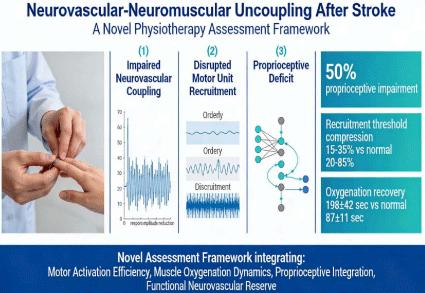
Neurovascular–Neuromuscular Uncoupling After Stroke: Physiological Effects on Motor Recovery and a Novel Physiotherapy-Based Physical Examination Framework
Background: Current stroke rehabilitation focuses on motor output parameters (strength, spasticity, motor recovery) without directly assessing neurovascular–neuromuscular coupling (NMC)—the synchronization between neural drive, muscle activation, and local blood flow. Emerging neuroscience indicates that impaired microvascular perfusion–muscle activation coupling represents a fundamental pathophysiological mechanism limiting motor recovery post-stroke, yet no standardized…

 DOI: 10.5281/zenodo.18448568 »
Review Article | Open Access
Published on: 22 Jan 2026
Article ID: wjptr.2026.a2207
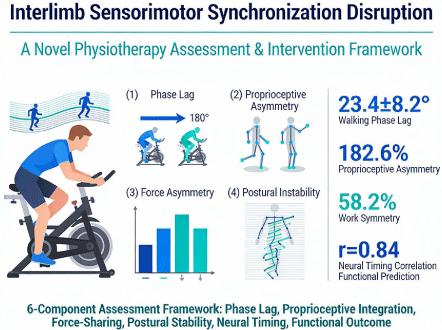
Disruption of Interlimb Sensorimotor Synchronization After Stroke: Physiological Mechanisms, Physical Examination Innovation, And Global Physiotherapy Intervention Models
Background: Current stroke rehabilitation treats limbs largely independently, despite mounting evidence that bilateral sensorimotor synchronization—the coordinated temporal and spatial control of bilateral limb movement—represents a core physiological requirement for functional recovery. No standardized physiotherapy assessment quantifies interlimb phase lag, bilateral proprioceptive integration, or force-sharing asymmetry as measurable physiological…


Research Article | Open Access
Published on: 15 Jan 2026
Article ID: wjptr.2026.a1501
Efficacy of Integrated Neuromechanical Rehabilitation on Symptom Resolution and Recurrence Rates in Medial Tibial Stress Syndrome: A Randomized Controlled Trial
Background: Medial tibial stress syndrome (MTSS) affects 4-35% of runners with substantial recurrence rates ranging from 25-57% following standard care protocols. While individual interventions (load management, gait retraining, strengthening) demonstrate independent efficacy, high-quality randomized controlled trial evidence evaluating integrated models combining all three components remains limited in the current literature.
Objective: To…


Research Article | Open Access
Published on: 10 Jan 2026
Article ID: wjptr.2026.a1004
Comparative Effectiveness of Neuromuscular Re-Education Versus Conventional Strengthening on Sensorimotor Control, Dynamic Knee Stability, Pain Modulation, Gait Performance, and Fall Risk in Geriatric Patients with Knee Osteoarthritis: A Randomized Controlled Trial
Background: Knee osteoarthritis (KOA) significantly impairs functional capacity and independence in geriatric populations, with increased susceptibility to falls and reduced quality of life. While both neuromuscular re-education (NMR) and conventional strengthening (CS) have demonstrated efficacy, comparative evidence remains limited.
Objective: This randomized controlled trial (RCT) compared the effectiveness of neuromuscular re-education versus…


Case Report | Open Access
Published on: 08 Jan 2026
Article ID: wjptr.2026.a0801
Impact of a Five-Year Clinical Pilates Intervention on Functional Mobility and Quality of Life in a 69-Year-Old Male with Idiopathic Inflammatory Myositis: A Case Study
Objective: The objective of this case study is to examine the effects of a structured Clinical Pilates (CP) intervention on functional mobility, balance, disability, quality of life, and selected biochemical markers in a 69-year-old male patient diagnosed with Idiopathic Inflammatory Myositis (IIM). Limited evidence regarding CP’s potential to improve functional mobility, balance, and psychosocial well-being in this population underscores the urgent need for exploratory,…


Case Presentation | Open Access
Published on: 05 Jan 2026
Article ID: wjptr.2026.a0502
Airplane Vestibular Repositioning Maneuver (AVRM): A Pediatric Adaptation of the Foster Half-Somersault Maneuver - A Case Report
Background: Children with histories of extreme prematurity and congenital hypotonia often present with delayed motor development and gait instability. Positional vestibular dysfunction may be underrecognized in this population, and standard canalith repositioning maneuvers are frequently not feasible for toddlers.
Case Presentation: This case report describes a 3-year-old child born at 23 weeks gestation with congenital hypotonia and delayed…


Research Article | Open Access
Published on: 03 Jan 2026
Article ID: wjptr.2026.a0306
Technology-Driven Lifestyle Disorders: Long Term Musculoskeletal, Biomechanical, and Postural Consequences of Smartphone, AI, and Work-From-Home Device Usage in Young and Working-Age Adults—A Preventive and Interventional Study
The rapid proliferation of smartphone and digital device usage among young and working age adults has created a silent epidemic of technology-driven musculoskeletal disorders (tech MSDs), yet preventive interventions remain underexplored in clinical practice. This prospective, longitudinal cohort study combined with a randomized controlled trial (RCT) investigates the biomechanical consequences of technology-driven postural dysfunction and evaluates the efficacy of physiotherapy-led…


Mini Review | Open Access
Published on: 24 Dec 2025
Article ID: wjptr.2025.l2401
Rehabilitation of Median Nerve and Radial Artery Injuries in Children: A Mini Review
Peripheral nerve Injuries in children, particularly those involving the median nerve and radial artery, represent complex and functionally significant conditions. Damage to these structures can lead to profound deficits in fine motor coordination, precision grip, sensory discrimination, and overall hand function. Early and well-structured rehabilitation is essential to prevent long-term complications and to maximize functional recovery, especially considering the high degree of…


Research Article | Open Access
Published on: 20 Dec 2025
Article ID: wjptr.2025.l2001
Effectiveness of an Integrated Multimodal Physiotherapy Rehabilitation Program on Proprioception, Quadriceps Strength, Gait Parameters, Pain, and Functional Outcomes After Total Knee Replacement: A Randomized Controlled Trial
Background: Post-operative recovery after total knee replacement (TKR) remains challenging, with persistent deficits in proprioception, quadriceps weakness, altered gait mechanics, and chronic pain affecting quality of life in up to 20% of patients.
Objective: To evaluate the effectiveness of an integrated multimodal rehabilitation program combining neuromuscular training, sensorimotor training, functional strengthening, and pain neuroscience…

Systematic Review | Open Access
Published on: 10 Dec 2025
Article ID: wjptr.2025.l1001
Mechanobiology-Driven Physiotherapy Intervention to Reverse Sarcopenic Cellular Aging: A Randomized Controlled Trial Integrating Myokine Profiling, Mitochondrial Function, and Epigenetic Biomarkers
Sarcopenia manifests as age-related skeletal muscle loss accompanied by progressive mitochondrial dysfunction, impaired myokine signaling, and epigenetic aging—yet few randomized controlled trials explore physiotherapy's capacity to reverse these molecular hallmarks. This double-blind parallel RCT evaluated a 12-week mechanobiology-optimized progressive resistance protocol versus stretching control in 80 community-dwelling sarcopenic adults (aged 65-75 years, EWGSOP2 criteria). Primary…
